Create Time: 08 ,29 ,2026
A scented stone is a simple form of passive fragrance diffusion. Instead of using electricity, flame, ultrasonic vibration, or active atomization, it relies on a porous solid material to absorb fragrance and gradually release volatile aroma compounds into the surrounding air.
This makes fragrance stones very different from scented candles, reed diffusers, and electric aroma machines. Their scent is usually softer and more localized, which makes them suitable for desks, wardrobes, bedside areas, bathrooms, and other small spaces where subtle fragrance is preferred.
SCENT-E currently includes Scented Stone within its Fragrance Gift range alongside Scented Candle, Reed Diffuser, Fragrance Stick, and Scented Spray.
A scented stone can be understood as a porous solid fragrance carrier. Its material contains very small pores and internal channels that allow fragrance liquid to enter the structure instead of remaining entirely on the surface.
The basic process involves four stages:
Absorption: Fragrance enters pores and microchannels inside the stone.
Retention: Part of the liquid remains temporarily stored within the porous structure.
Evaporation: Volatile aroma compounds gradually move back toward the surface and enter the air.
Passive diffusion: Normal air movement distributes the fragrance around the immediate area.
Unlike a candle, the stone does not require heat to release fragrance. Unlike an electric diffuser, it does not actively generate a mist.
The result is a quieter and usually more subtle scenting method based primarily on natural evaporation.
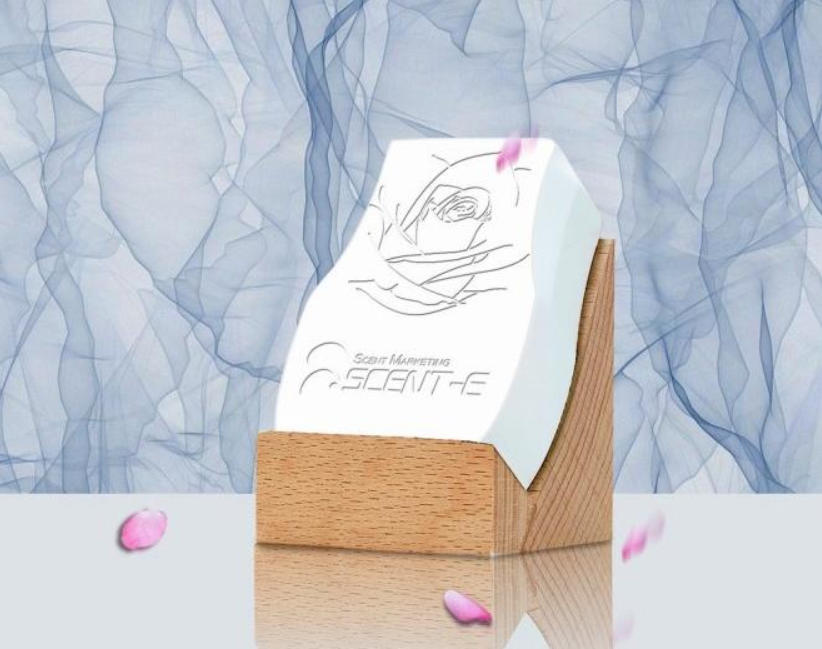
The important characteristic of a scented stone is not simply that it is solid. Its internal structure contains small voids and channels that increase the surface area available for contact with fragrance liquid.
When fragrance is applied, part of the liquid enters those spaces and is temporarily retained. Volatile fragrance components then gradually evaporate from exposed surfaces and pore openings.
This means the stone acts as a small fragrance reservoir.
However, it does not hold fragrance permanently. As aroma compounds continue to evaporate, the amount remaining inside the material decreases and the perceived scent gradually becomes weaker.
This physical process explains why scented stones can continue releasing fragrance after the visible surface appears dry.
In simple terms, a scented stone works because its porous structure temporarily holds fragrance liquid and gradually releases volatile aroma compounds into the surrounding air.
A fragrance stone does not release fragrance at exactly the same rate all the time. Environmental conditions and fragrance characteristics can change how quickly aroma compounds leave the porous material.
Several factors are especially important:
Temperature: Warmer conditions generally increase evaporation, which can make the fragrance feel stronger but may also shorten the period of noticeable scent.
Airflow: Moving air carries aroma away from the surface more quickly. Gentle airflow can help distribution, while strong ventilation may dilute the fragrance.
Surface area: A larger exposed surface can provide more area from which volatile compounds can evaporate.
Fragrance composition: Different aroma materials have different volatility, so some notes disappear more quickly than others.
Amount applied: A freshly re-scented stone may initially smell stronger before gradually becoming more subtle.
This is why the same scented stone can perform differently in different rooms.
A warm bathroom may produce a stronger scent than a cool wardrobe, while a stone placed near moving air may seem more noticeable than one positioned in a completely still corner.
Although all three can fragrance indoor environments, they use very different diffusion mechanisms.
| Feature | Scented Stone | Reed Diffuser | Scented Candle |
|---|---|---|---|
| Heat required | No | No | Yes |
| Electricity | No | No | No |
| Main diffusion method | Porous evaporation | Capillary action | Heat-assisted evaporation |
| Fragrance source | Absorbed into solid material | Liquid reservoir | Fragrance incorporated into wax |
| Typical scent style | Subtle and localized | Continuous passive scent | Stronger while burning |
| Maintenance | Reapply fragrance when suitable | Refill liquid / replace reeds | Wick and burn management |
A reed diffuser continuously draws liquid fragrance from a bottle through porous reeds. A candle relies on heat to melt scented wax and increase fragrance release.
A scented stone has neither a liquid reservoir nor a heat source. Fragrance is stored directly inside the porous material and gradually released through evaporation.
This is why similar fragrance formulas can create noticeably different experiences depending on the delivery format.
Passive fragrance diffusion has natural limits.
A scented stone can work well in a small bedroom, beside a desk, inside a wardrobe, or in a decorative bathroom corner because the fragrance only needs to remain noticeable within a limited area.
Large commercial spaces are very different. Hotel lobbies, shopping centers, and airport halls contain much more air and often have powerful ventilation systems, high ceilings, and continuous movement.
In these environments, passive evaporation cannot distribute fragrance in the same way as a powered scent machine or HVAC-based system.
This does not mean that a scented stone is less effective as a fragrance product. It simply serves another purpose.
SCENT-E's Scented Stone is positioned within its Fragrance Gift collection, while larger commercial environments can be supported by the company's wall-mounted, floor-standing, and HVAC scenting systems.
The right fragrance method therefore depends on space size, desired intensity, and how far the scent needs to travel.
As volatile compounds gradually evaporate, a fragrance stone will normally become less noticeable over time.
Some products are designed so that fragrance can be reapplied. However, the exact method depends on the material and product design.
Residual fragrance may remain inside the porous structure even after the scent becomes faint. If a dramatically different fragrance is added, the old and new scent profiles may mix for a period of time.
Surface condition also matters. Dust, oils, or residue may influence how additional fragrance is absorbed.
For these reasons, re-scenting should follow the instructions for the specific product rather than assuming that every fragrance stone can be repeatedly saturated or switched between completely different scents.
A scented stone shows that fragrance diffusion does not always require heat, electricity, or mechanical atomization.
Its operation is based on a simple physical relationship between porous material and volatile fragrance. The internal structure temporarily stores liquid, while evaporation gradually transfers aroma compounds into the surrounding air.
Temperature, airflow, surface area, fragrance composition, and room size then influence how strongly that scent is perceived.
This makes fragrance stones especially suitable for subtle, localized scenting, where simplicity, decorative value, and passive operation are more important than large-area fragrance coverage.
A scented stone is a porous solid material that absorbs fragrance and gradually releases aromatic compounds into the air.
They store fragrance within small pores and release it slowly through natural evaporation.
No. They work entirely through passive fragrance release.
There is no fixed duration. It depends on fragrance composition, temperature, airflow, material structure, and the amount applied.
Some scented stones can be re-scented, depending on their material and product design.
A scented stone stores fragrance directly inside a porous solid, while a reed diffuser continuously draws liquid fragrance from a reservoir through reeds.
This is the first one.



 English